How to Select the Right Valve for Oil & Gas Applications
How to Select the Right Valve for Oil & Gas Applications
Valves are among the most critical components in oil and gas production and processing systems. From wellheads and offshore platforms to pipelines, gas processing facilities, refineries, and petrochemical plants, valves are responsible for controlling, isolating, and directing the flow of liquids and gases throughout the process. Although valves may appear to be relatively simple mechanical components, selecting the right valve for an oil and gas application requires careful engineering consideration. Pressure, temperature, fluid characteristics, materials, operating conditions, safety requirements, and applicable standards can all influence valve selection. Choosing the correct valve is therefore not simply a purchasing decision—it is an important part of achieving safe, reliable, and efficient process operation.
Why Valve Selection Matters in Oil & Gas
Oil and gas facilities often operate under demanding conditions involving high pressures, elevated or low temperatures, corrosive fluids, hydrocarbons, gases, chemicals, and hazardous environments. A valve that performs well in one application may not necessarily be suitable for another. Incorrect valve selection can contribute to leakage, excessive pressure drop, poor flow control, premature wear, corrosion, frequent maintenance, or reduced system reliability. For this reason, engineers should evaluate the complete operating conditions before determining the appropriate valve type, material, pressure class, sealing system, actuation method, and configuration.
Understanding Different Types of Industrial Valves
Different valve designs perform different functions within an oil and gas process.
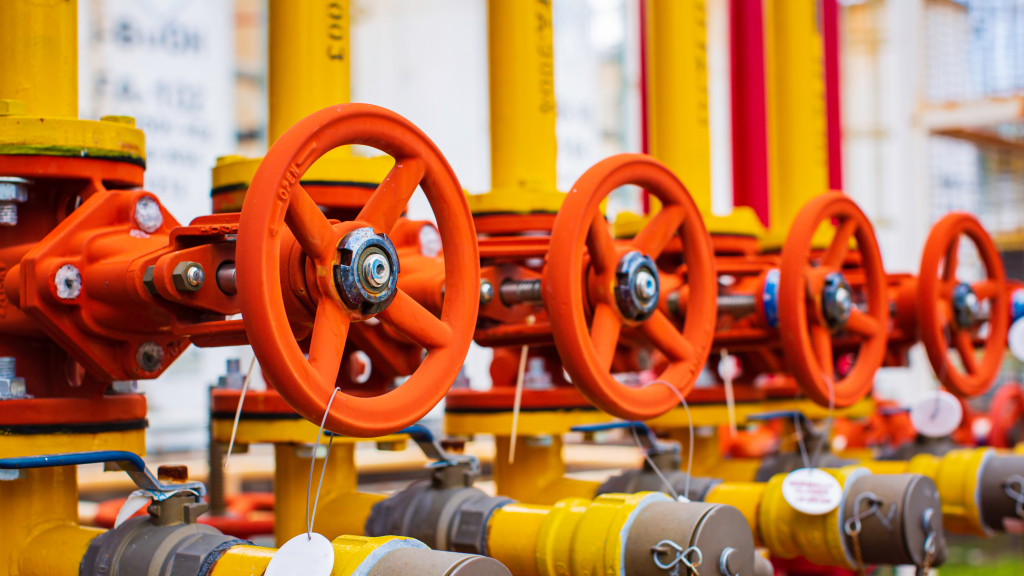
- Ball Valves are widely used where reliable isolation and quick shut-off are required. Their quarter-turn operation makes them suitable for many pipeline and process applications.
- Gate Valves are commonly applied for isolation service where a relatively unrestricted flow path is desirable when the valve is fully open.
- Globe Valves can be suitable for applications requiring throttling or flow regulation because their design provides greater control over flow compared with many simple isolation valves.
- Check Valves automatically help prevent reverse flow and can protect pumps, compressors, pipelines, and other process equipment from undesirable backflow.
- Control Valves continuously regulate process variables by adjusting flow according to signals from the process control system. They play an important role in maintaining stable pressure, flow, temperature, or level.
Other specialized valve technologies may be required depending on the process, fluid characteristics, and project specifications. The key principle is straightforward: the valve should be selected for the application—not the application forced to fit the valve.
Key Factors When Selecting a Valve
Successful valve selection begins with understanding the process. Engineers should consider the fluid being handled and whether it is crude oil, natural gas, condensate, produced water, chemicals, or another process medium. Operating and design pressure, temperature, required flow capacity, corrosion potential, solids content, and operating frequency can all affect the final selection. Materials of construction are particularly important. Valve body, trim, seat, seals, and other wetted components should be compatible with both the process fluid and operating environment. The required function must also be clearly understood. A valve intended for emergency isolation has different requirements from one used for continuous flow control. Actuation is another consideration. Depending on the application, valves may be manually operated or equipped with pneumatic, electric, or hydraulic actuators and integrated into plant control or safety systems. Finally, the applicable project specifications, codes, standards, inspection requirements, and certification requirements should be considered during the engineering and procurement process.
Valves for Offshore Oil & Gas Applications
Valve selection becomes particularly important in offshore oil and gas applications, where reliability, safety, corrosion resistance, footprint, weight, and maintenance accessibility can significantly influence engineering decisions. Offshore facilities may also expose equipment to challenging marine environments while maintenance opportunities can be more limited than at conventional onshore facilities. For these applications, selecting a valve based solely on nominal size and pressure rating is rarely sufficient. Materials, sealing performance, actuation, corrosion protection, maintainability, operating environment, and project requirements should be evaluated as part of the complete valve solution. Reliable equipment selection at the engineering stage can help reduce operational problems throughout the asset lifecycle.
Valves as Part of an Integrated Process Solution
A valve rarely operates independently. Within an oil and gas facility, valves interact with piping systems, pumps, compressors, flow meters, pressure and temperature instruments, metering systems, chemical injection packages, and process control systems. For example, a metering package may require isolation valves, control valves, check valves, and instrumentation working together to achieve reliable measurement and process control. Similarly, a chemical injection package may require valves and accessories specifically selected for chemical compatibility, injection pressure, dosing requirements, and safe isolation. Looking at valves as part of the overall process—rather than as individual components—helps engineers develop more reliable and maintainable systems.
Reliability Begins with the Right Engineering Decision
Valve lifecycle cost extends beyond the initial purchase price. A lower-cost valve that requires frequent maintenance, creates operational problems, or does not perform reliably under actual process conditions may ultimately become more expensive over the life of the facility. For critical applications, engineering teams should therefore consider reliability, materials, maintainability, product quality, technical support, spare parts availability, and lifecycle performance alongside initial cost. The objective is not simply to purchase a valve. It is to select a valve that performs the required function reliably throughout its intended service.
Multiphase Oil & Gas: Valve Solutions for Industrial and Oil & Gas Applications
At Multiphase Oil & Gas, we approach valve selection from an engineering perspective. Rather than focusing solely on size or pressure class, our objective is to understand the application—including process fluid, operating conditions, required function, materials, actuation, installation environment, and project specifications—before identifying an appropriate valve solution. Our valve portfolio supports a range of oil & gas, offshore, onshore, petrochemical, energy, and industrial applications, with solutions selected according to specific process and project requirements.
Valve solutions can also be integrated with our broader engineering capabilities, including flow measurement, metering systems, instrumentation, chemical injection systems, and engineered package solutions. This integrated approach enables customers to work with a technical partner who understands not only the individual component, but also how that component interacts with the overall process.
The Right Valve Starts with the Right Application Data
There is no single “best valve” for every oil and gas application. The right solution depends on what the valve needs to do, what fluid it will handle, the conditions under which it will operate, and the requirements it must satisfy. That is why effective valve selection begins with engineering. Engineered for the Application. Selected for Reliability. Looking for industrial valves or oil & gas valve solutions in Thailand? Contact Multiphase Oil & Gas with your valve datasheet, process conditions, technical specification, or project requirements. Our team can help evaluate the application and identify a suitable valve solution.
HOTLINE:
091-187-1111
EMAIL:
sales@multiphase-og.com
LINE ID:
@multiphase